Want to learn how to play Minesweeper without accidentally clicking a hidden mine? Minesweeper Classic is a popular logic puzzle where every number provides a clue about the dangerous squares surrounding it. Your objective is to identify the hidden mines and reveal every safe square on the board.
Although the rules are easy to understand, winning requires careful observation, logical thinking and patience. A single incorrect move can end your game, so learning how to interpret the numbered clues is essential.
In this beginner-friendly guide, you will learn the Minesweeper rules, understand what each number means, discover how to flag mines and explore practical strategies for solving the board.
You can also play Minesweeper Classic online on VIPGame24 while following the instructions in this article.
What Is Minesweeper?
Minesweeper is a single-player logic puzzle played on a grid of covered squares. Some squares hide mines, while others contain numbers that provide clues about nearby mines.
Your objective is to uncover every square that does not contain a mine. If you reveal a mine, the game ends.
Each numbered square provides information about the eight surrounding positions, including horizontal, vertical and diagonal neighbours.
For example, a square displaying the number 2 indicates that two of its neighbouring squares contain hidden mines.
The challenge is to use these numbers to identify dangerous locations and determine which squares are safe to open.
How to Play Minesweeper: Basic Rules
Before developing advanced strategies, understand the basic mechanics of the game. These rules form the foundation of every Minesweeper challenge.
1. Understand the Game Grid
The game board contains multiple rows and columns of covered squares. Hidden underneath these squares are mines and safe spaces.
When you reveal a safe square, it may display a number or appear blank.
A numbered square provides information about nearby mines, helping you decide which surrounding squares are dangerous.
2. Learn What the Numbers Mean
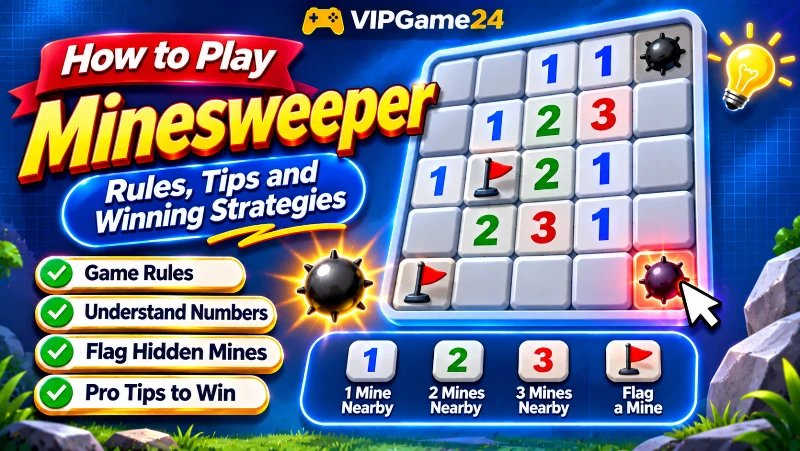
Numbers are the most important clues in Minesweeper. They tell you exactly how many mines are hidden in the eight neighbouring squares.
| Number | Meaning |
|---|---|
| 1 | One neighbouring mine |
| 2 | Two neighbouring mines |
| 3 | Three neighbouring mines |
| 4 | Four neighbouring mines |
| 5 | Five neighbouring mines |
| 6 | Six neighbouring mines |
| 7 | Seven neighbouring mines |
| 8 | All eight neighbouring squares contain mines |
Remember that diagonal squares also count. Beginners sometimes overlook diagonal positions when calculating the number of surrounding mines.
3. Identify and Flag Hidden Mines
When the numbered clues prove that a covered square contains a mine, mark it with a flag if the game supports flagging.
Flags help you remember dangerous positions and avoid opening them accidentally.
For example, if a numbered square displays 1 and has only one covered neighbouring square remaining, that covered square must contain a mine.
However, do not place flags randomly. An incorrect flag can mislead your future decisions.
4. Find Safe Squares
Once you identify the positions of nearby mines, look for covered squares that must be safe.
For example, imagine a square displaying the number 1 with one confirmed mine already flagged beside it. Any other covered neighbouring squares of that numbered square are safe.
This is one of the most useful deductions in Minesweeper. Every correctly identified mine can provide additional information about the surrounding board.
5. Continue Until Every Safe Square Is Revealed
Keep examining the numbered clues, marking confirmed mines and opening safe squares.
Your objective is to reveal all non-mine squares. In standard Minesweeper, you do not necessarily need to flag every mine to win.
How to Read a Minesweeper Board
Learning to interpret the board is more important than making quick moves. Every revealed number provides information that can help you solve nearby positions.
Understanding a Number 1
A number 1 means exactly one of its eight neighbouring squares contains a mine.
If only one neighbouring square remains covered and all other neighbours are known to be safe, you can identify that covered square as a mine.
Understanding a Number 2
A number 2 indicates that two neighbouring squares contain mines.
Count the covered positions surrounding the number and compare them with any mines you have already confirmed.
If two neighbouring mines have already been identified, every remaining covered neighbour is safe.
Understanding a Number 3
A number 3 indicates that three neighbouring positions contain mines.
Look at the nearby covered squares and compare the available possibilities with other numbered clues. Sometimes a neighbouring number provides the information needed to identify the exact mine positions.
Understanding a Blank Square
A blank square represents a location with no neighbouring mines. In classic Minesweeper implementations, revealing a blank square often opens additional neighbouring safe squares automatically.
This creates a larger revealed area and gives you more numbered clues to work with.
7 Best Minesweeper Strategies for Beginners
Once you understand the rules, these practical strategies can help you make better decisions and avoid unnecessary mistakes.
1. Start with an Open Area
Your opening move gives you the first set of clues. Examine the newly revealed area carefully and look at the boundary between uncovered and covered squares.
Rather than immediately clicking different positions, use the available numbers to find logical starting points.
2. Count All Eight Neighbouring Squares
Always remember that Minesweeper numbers include diagonal positions.
When analysing a number, check the squares above, below, left, right and in all four corners.
Forgetting diagonals can lead to incorrect deductions and unnecessary losses.
3. Use the Number of Covered Squares
One of the simplest logical rules is comparing the number displayed on a square with its remaining covered neighbours.
- If a 1 has exactly one covered neighbour, that neighbour is a mine.
- If a 2 has exactly two covered neighbours, both are mines.
- If a 3 has exactly three covered neighbours, all three are mines.
This method works when all those covered neighbours are the only unresolved positions surrounding the clue.
4. Use Confirmed Flags to Find Safe Positions
Once you have marked the exact number of mines surrounding a numbered square, examine its other covered neighbours.
If the number of confirmed adjacent mines matches the displayed number, the remaining covered neighbours are safe.
This allows you to uncover more of the board without making random guesses.
5. Compare Two Nearby Numbers
Sometimes one number does not provide enough information to identify a particular mine.
In these situations, examine two or more nearby numbers together.
For example, a 2 may indicate that two of three covered positions contain mines. A neighbouring 1 may help narrow down which positions are dangerous.
Combining multiple clues is an important skill for progressing beyond beginner-level boards.
6. Avoid Unnecessary Guessing
Before opening a square, check whether the surrounding numbers provide enough information to determine whether it is safe.
Do not select a covered position simply because it looks like a convenient option. Examine nearby clues and possible mine positions first.
Some Minesweeper versions can require guessing in certain situations, so not every board or implementation guarantees a purely logical solution.
7. Slow Down Near the End
When most of the board has been revealed, the remaining squares may become more difficult to analyse.
Take your time, revisit the nearby numbered clues and verify your flags before opening another position.
A few extra seconds of careful thinking can prevent an otherwise avoidable mistake.
Common Minesweeper Mistakes to Avoid
Even experienced players can make mistakes when they overlook important details. Avoid these common problems.
Ignoring Diagonal Squares
Numbers count diagonal neighbours as well as horizontal and vertical positions. Always examine all eight neighbouring squares.
Flagging Squares Without Evidence
A flag should represent a mine you have logically identified. Placing flags based on assumptions can make future deductions unreliable.
Opening Squares Too Quickly
Moving quickly without examining the numbers can cause you to reveal a mine unnecessarily. Check the clues before choosing your next square.
Forgetting Previously Revealed Clues
Do not concentrate only on the newest area of the board. Earlier numbered squares may contain information that becomes useful as new positions are revealed.
Confusing the Mine Counter with Proof
A mine counter may help you keep track of your flags, but reaching zero does not automatically prove that every flag is correctly placed. Verify positions using the numbered clues.
How to Get Better at Minesweeper
Improving at Minesweeper requires practice and a consistent approach to solving the board.
Practise on Smaller Boards
Start with a smaller or beginner-level board when that option is available. Fewer squares make it easier to understand numbered clues and follow the logic.
Learn Common Number Patterns
As you play more games, you may begin recognizing familiar arrangements of numbers and covered squares.
Learning these patterns can help you make deductions more efficiently.
Review Incorrect Moves
When you lose a game, examine the position where you made the mistake. Determine whether you missed a diagonal clue, miscounted a neighbour or made an unsupported assumption.
Focus on Logic Rather Than Speed
Speed becomes useful after you understand the rules. Initially, concentrate on making correct deductions rather than completing the board as quickly as possible.
How to Play Minesweeper Classic on VIPGame24
Ready to put these strategies into practice? VIPGame24 provides a Minesweeper Classic game page where you can explore the numbered-grid puzzle.
- Visit the Minesweeper Classic game page.
- Allow the on-page game player to load.
- Read the displayed instructions and control information.
- Reveal a square to begin exploring the board.
- Study the numbered clues and identify dangerous positions.
- Use the game’s available flag controls when you identify a mine.
- Continue revealing safe squares until you complete the challenge or hit a mine.
The exact board configuration and controls can depend on the game implementation. Follow the instructions provided by the VIPGame24 game player.
Minesweeper vs Other Puzzle Games on VIPGame24
If you enjoy Minesweeper, you may also like other logic and number-based games in the VIPGame24 collection.
| Game | Main Challenge | Game Page |
|---|---|---|
| Minesweeper Classic | Find hidden mines using numbered clues. | Play |
| 2048 | Merge identical numbered tiles. | Play |
| Chess Grandmaster | Solve chess challenges using strategic moves. | Play |
| Word Finder | Find words in a grid of letters. | Play |
| Black Jack Grid | Arrange cards horizontally and vertically to reach 21. | Play |
Each game provides a different type of challenge, from logical deduction to number combinations and strategic planning.
Frequently Asked Questions About Minesweeper
What is the main objective of Minesweeper?
The objective is to reveal every square that does not contain a mine. You use numbered clues to identify dangerous positions and determine which squares are safe to open.
What do the numbers mean in Minesweeper?
Each number indicates how many mines are hidden in the eight surrounding squares, including diagonals.
How do you flag a mine in Minesweeper?
Use the flag control provided by the game to mark a square you have identified as a mine. The exact input method may vary between desktop and mobile implementations.
Do you need to flag every mine to win?
In standard Minesweeper rules, no. You win by revealing every safe square. Flags are primarily used to keep track of dangerous positions.
What happens if you click a mine?
Opening a mine ends the game in standard Minesweeper. You will generally need to start another round to try again.
What does a blank square mean in Minesweeper?
A blank square means there are no mines in its eight neighbouring positions. Classic implementations often reveal nearby safe squares automatically.
Is Minesweeper a game of luck or logic?
Minesweeper is primarily a logic puzzle because numbered clues provide information about mine locations. However, some board positions and game implementations may require a guess when the available clues cannot determine a safe move.
Can beginners play Minesweeper?
Yes. Beginners can start with smaller boards and gradually learn how to interpret numbered clues, identify mines and uncover safe positions.
Where can I play Minesweeper online for free?
You can play Minesweeper Classic on VIPGame24 through its individual browser game page.
Start Playing Minesweeper on VIPGame24
Minesweeper is a simple game to learn but offers plenty of opportunities to improve your logical thinking and problem-solving approach.
By understanding the numbered clues, identifying confirmed mines, recognizing safe squares and avoiding unnecessary guesses, you can approach each board with greater confidence.
Start with a beginner-friendly challenge, practise the basic strategies and gradually develop your Minesweeper skills.
Play Minesweeper Classic online on VIPGame24.
Looking for more brain challenges? Explore our guide to the best free online puzzle games and discover more games in the Puzzle & Logic category.